
The Real Reason Every Decision Still Runs Through You
Leadership • Jul 29, 2026, 8:30:00 AM • Written by: Thomas Rechtien
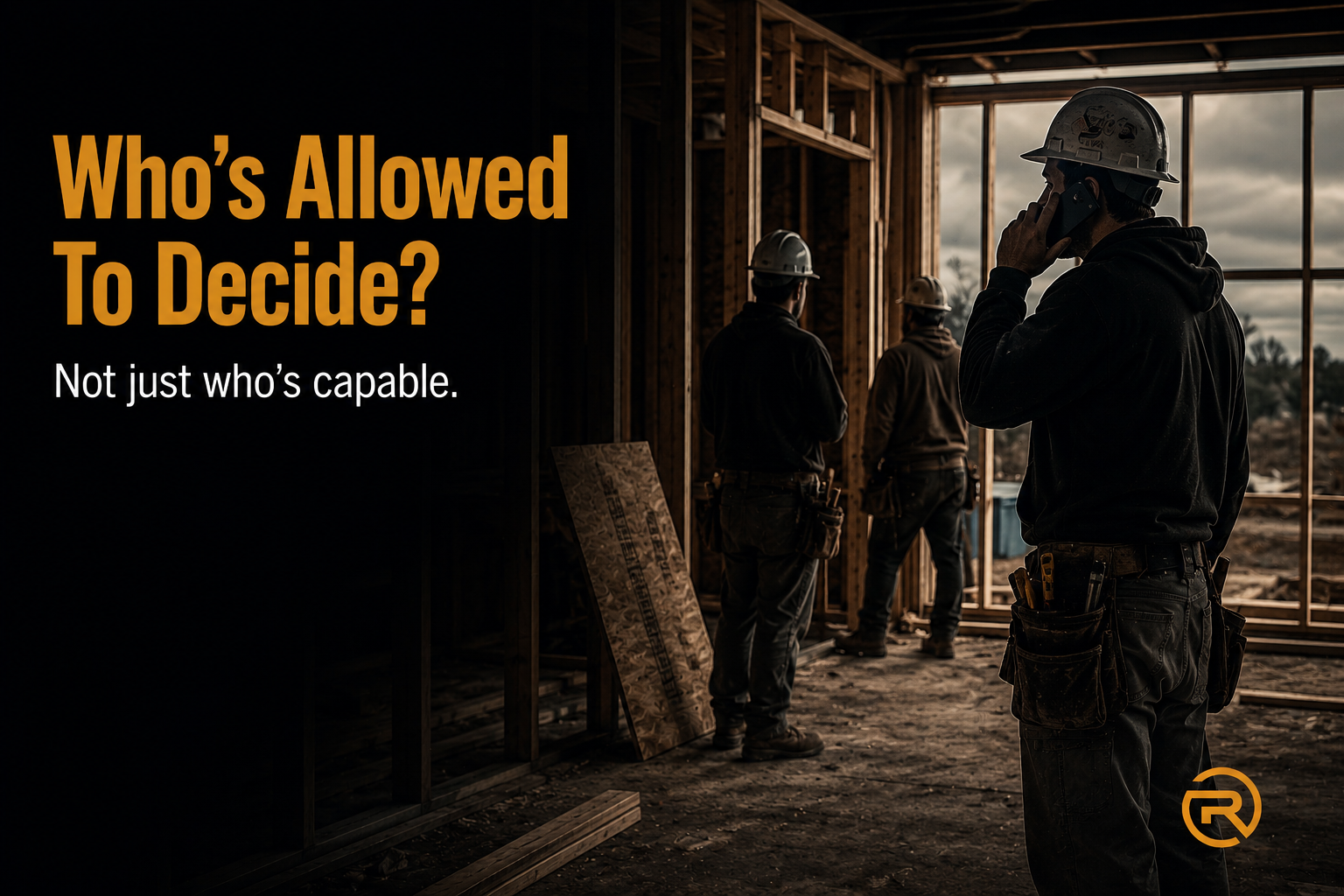
A $400 change order just stopped a $40,000 job.
A wall needs to come down two feet further than the plan called for. Your crew lead knows it. He's standing there with four guys and a saw, and none of them are working, because the change needs your sign-off first. You're in a meeting across town. Forty-five minutes pass before you call back. The answer is three words — "yeah, do it" — but the job just lost most of an hour it didn't have to lose.
It happens every week. Some job, some shop, somewhere in the company. Multiply that by every week of the year and you're not looking at one $400 decision anymore. You're looking at the actual shape of your business.
It Feels Like a People Problem. It's a Structure Problem.
Most owners read that scene and think: I need better people.
That's usually not it. Operational research on small-business bottlenecks describes the same pattern over and over: decisions, approvals, and problem-solving all route through one person, and when that person is unavailable, the work doesn't pause politely — it backs up. One delayed decision holds up the next task. One overloaded owner slows the whole operation, no matter how good the crew standing around waiting for the answer actually is.
Your crew lead in that scene wasn't incapable of deciding. He was capable and unauthorized. Those are not the same problem, and they don't have the same fix.
The Difference Between "No Judgment" and "No Permission"
Some decisions genuinely need you. Most of the ones that reach you do not.
Big capital commitments, safety calls, anything that changes the relationship with a client — those should land on your desk. That's not the bottleneck. The bottleneck is everything else: the routine material substitution, the half-day schedule shift, the $200 tool rental nobody wanted to approve without asking first.
Your team isn't bringing you those because they can't handle them. They're bringing them to you because no one ever told them, explicitly, where their own authority ends. Silence isn't neutral. When the boundary was never stated, the safe move is always to ask.
What It's Actually Costing You
Run the math on your own crew before you decide this is a small problem.
If your foreman brings you three decisions a day, and each one costs you fifteen to twenty minutes once you count the interruption, the context switch, and the wait for you to get back to him — that's close to an hour a day. Five hours a week. Roughly 250 hours a year, spent on decisions that, with one written boundary, never needed to reach you at all.
That's a quarter of an owner's working year, gone to decisions that were never actually owner-level in the first place.
Decision Rights Are Not a Personality Change. They Are a List.
You don't fix this by trusting your team more. You fix it by writing down what they're already trusted to do.
A simple structure works better than a philosophy. Three tiers, in plain language your crew can actually use in the field:
Decide and inform — routine calls under a dollar threshold you set. They make the call, then tell you it happened. No approval loop.
Decide and check in same day — moderate-stakes calls where they act, then confirm with you before end of day so nothing sits unresolved.
Bring it to me first — safety, large capital, anything client-facing or irreversible. This stays yours, and it should.
The exact dollar amounts and categories are yours to set — a $500 material substitution might be a nothing decision in one shop and a real one in another. What matters is that the line exists in writing, not just in your head.
The Shift Isn't Trust. It's Clarity.
You already trust your people more than your current structure lets them show.
Alignment isn't a poster on the break room wall. It's a written boundary everyone on the team actually knows — so the decision that used to need you now just needs someone who already knows how you'd have made it.
This Week's Move
Pick one decision category — the one you get asked about most — and give it away in writing this week.
Not a policy manual. A text message or a one-line note on the shop whiteboard is enough to start: here's what you can decide without me, here's the number, go. Watch what happens the next time that decision comes up.
This builds directly on the test from the first post in this series — if you haven't run it yet, start there before you decide which decisions to hand off first.
What's one decision that landed on your desk this week that never actually needed you?
FAQs
How do I know which decisions are safe to delegate first? Start with whatever shows up most often and costs the least when someone gets it wrong. Frequency and low stakes together are the safest place to test a new boundary — you get fast feedback on whether the line you drew is in the right place, without much downside if it isn't.
What if my team makes the wrong call after I give them the decision? They will, occasionally — that's the cost of the system working. A wrong call inside a clear boundary is cheap to fix and teaches the boundary faster than a memo ever will. Correct the decision, not the authority. Pulling the authority back the first time someone gets it wrong just teaches everyone to stop deciding again.
Doesn't this slow things down while people learn? For a few weeks, maybe slightly. Compare that against the 250 hours a year most owners are already losing to decisions that never needed them. The short-term dip is smaller than the cost of staying the bottleneck indefinitely.
How does this connect to the "Do you own the business" test? Directly. Decision rights are the mechanism — the actual thing you build so the business can pass that test. If nothing changes about who's allowed to decide what, the business will fail the same test again next year.
Ready to Build a Business That Runs Without You?

Thomas Rechtien
Thomas Rechtien is a leadership strategist and execution coach with more than 25 years of experience helping owner-led businesses break through the plateau and build companies that run without them. As the founder of Rechtien Consult, Thomas works as an embedded partner inside leadership teams — not as an outside consultant who delivers a deck and disappears, but as someone who gets in the trenches and builds alongside you. His work is built on four fundamentals: Clarity, Alignment, Focus, and Momentum — the From Stuck to Scaling framework that turns operational chaos into disciplined, scalable execution. Before founding Rechtien Consult, Thomas operated at the highest levels of industrial and manufacturing businesses across the U.S. and Europe — serving as CEO, COO, and EVP in steel and industrial companies. He has led turnarounds, scaled international operations, and built high-performing sales organizations in environments where execution is the difference between survival and success. He primarily works with companies between $5M and $100M in revenue across manufacturing, construction, and B2B services. Based in Houston, Texas, Thomas works with clients across the U.S. and Europe.